Resources & Framework Overview
Understanding EOS®, 7 Stages of Growth™, and how they work together to help your company run better and grow smarter.
27 Challenges Assessment
The 27 Challenges assessment is a research-backed online diagnostic built on the 7 Stages of Growth framework. Based on research into hundreds of growing businesses, it identifies the 27 challenges that growing companies face most often — and helps you understand which ones are active in your organization right now.
Complete it in about 30 minutes. You will immediately receive a copy of your results, and I will follow up with a free call to review them together — no commitment required.
What you'll learn: Which of the 27 growth challenges are affecting your company, how they rank in severity, and where to focus first to unlock your next level of growth.
Who Should Take It?
- Founders or CEOs who sense something is holding the business back — but can't pinpoint what
- Leadership teams that feel stuck at the same revenue or headcount ceiling year after year
- Companies considering an X-Ray diagnostic who want a preview of the framework first
- Any business owner who wants a research-backed, objective read on their company's biggest growth challenges
What is EOS?
The Entrepreneurial Operating System® (EOS®) is a comprehensive set of simple concepts and practical tools designed for entrepreneurs and leadership teams to gain control, focus, and alignment.
It is a method to "run a company"—aligning people and processes to maximize success. EOS companies focus on Six Key Components:
- Vision — Ensuring everyone is 100% on the same page regarding direction.
- People — Having the right people in the right seats.
- Data — Managing the business through metrics and a weekly scorecard.
- Issues — Creating a healthy, open environment to solve problems.
- Process — Documenting and following core processes for consistency.
- Traction® — Bringing discipline and accountability to execution.
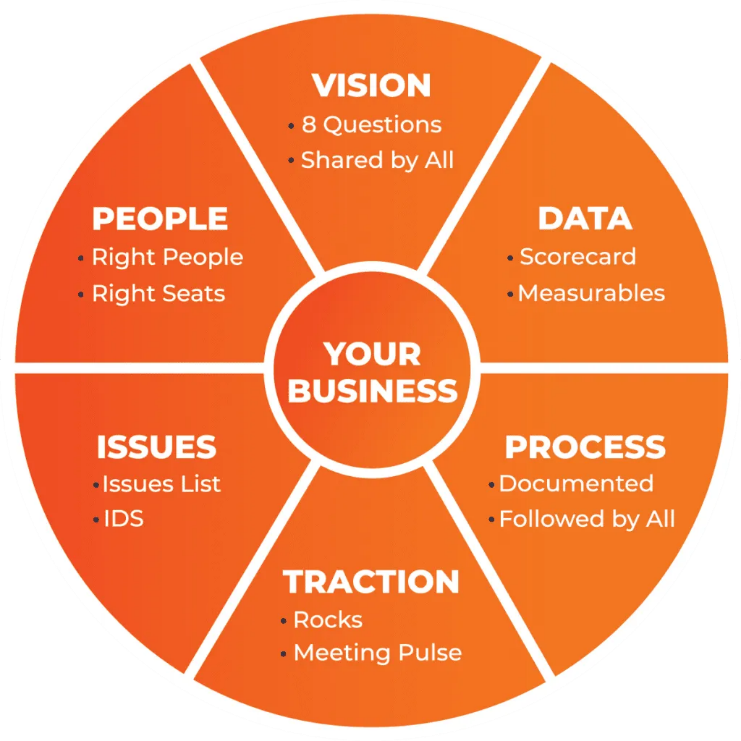
The Six Key Components of EOS® (click to enlarge)
EOS in Practice
EOS provides tools like the Vision/Traction Organizer (V/TO), the Level 10 Meeting, Rocks (90-day priorities), and the Issues Solving Track—all designed to help leadership teams run more effective meetings, make better decisions, and drive consistent execution.
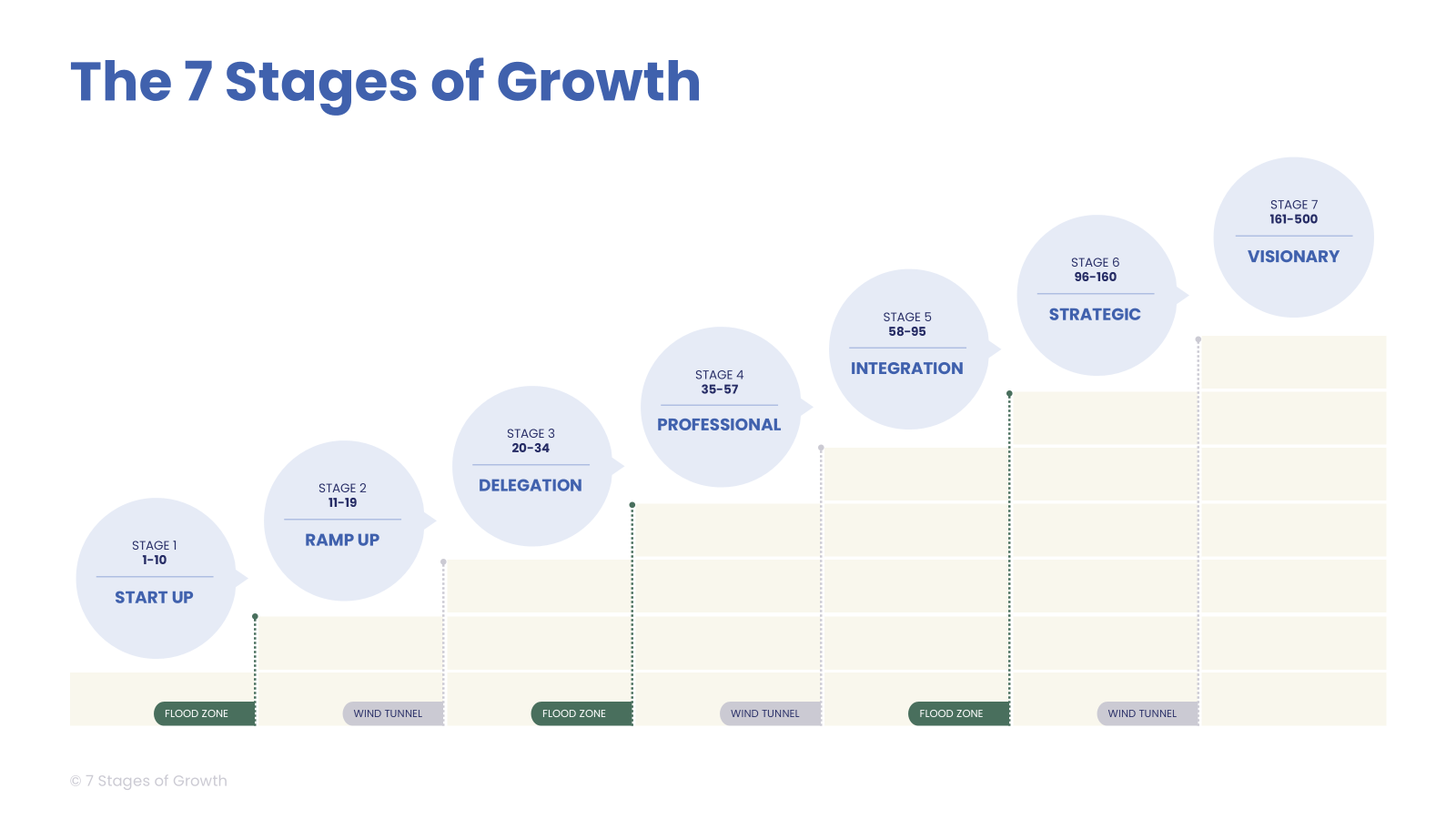
The 7 Stages of Growth™ — from Start Up (1–10 employees) to Visionary (161–500 employees) (click to enlarge)
What is 7 Stages of Growth?
Research into over 650 successful businesses revealed the patterns of what leaders need to focus on—and when. Between 1 and 500 employees, businesses go through seven distinct stages of growth. What worked in one stage won't carry you through future stages, and unresolved issues from one stage carry over to the next.
The 7 Stages of Growth framework provides a treatment plan tailored to the specific needs of each business. It addresses the underlying issues that are preventing a business from reaching its full potential.
- Diagnose the root causes of business growth challenges
- Develop a customized plan for sustainable business growth
- Align leadership teams around a course of action
- Strengthen the business's resilience against future setbacks
- Achieve peak business performance and long-term vitality
What Each Stage Prescribes
The most critical issues to address at your exact stage
5 rules your organization must follow at this stage
The priority areas that unlock your next stage
The right balance of growth vs. operational leadership
Stage-specific leadership approaches for CEO, team & employees
Customized ratio of visionary, manager, and specialist roles
The leadership skills that matter most at this stage
Stage-appropriate leadership style for the CEO
The Sprint Format
7SG operates in six-month sprints: a two-day leadership team kickoff (the "X-Ray"), monthly two-hour progress reviews, and an end-of-cycle X-Ray to wrap up and plan the next sprint. This structure creates momentum, accountability, and measurable progress every six months.
Why EOS and 7SG Complement Each Other
EOS Answers: How
EOS gives you the tools, rhythms, and structure to run your business—how to hold meetings, how to prioritize goals, how to solve issues and maintain accountability. It's the operating system for your company.
7SG Answers: What
7SG tells you what to focus on now, and which issues to anticipate before they develop. It provides a research-backed map of where you are on the growth curve and exactly what needs to change at your specific stage.
Leadership Calibration: A Key Advantage of the Combined Approach
7SG helps EOS leaders calibrate their leadership styles for the company's stage of growth. For example:
Visionary and commanding leadership styles build momentum and establish direction.
Coaching and facilitative leadership empowers managers and builds organizational capability.
Strategic and servant leadership creates a self-managing, high-performance organization.
Matching leadership styles to the company's growth stage ensures the organization builds the right skills and habits for long-term success—something EOS alone doesn't prescribe.
Integrators vs. Implementers: What's the Difference?
These are two very different roles—and understanding the difference is critical to making EOS work.
EOS Implementer
Implementers are certified, expert coaches and facilitators who teach leadership teams how to use the EOS tools. They work primarily through periodic quarterly and annual planning sessions, helping companies strengthen the Six Key Components to improve focus, alignment, and traction.
- ✔Certified EOS trainer and facilitator
- ✔Leads quarterly and annual sessions
- ✔Optimizes EOS tools and concepts
- ✔Works with CEO and leadership team periodically
EOS Integrator
Integrators are high-level leaders within EOS companies who execute the company's vision, drive accountability, and manage day-to-day operations. They lead Level 10 meetings and turn the Visionary CEO's ideas into actionable, measurable, and consistent results. In many companies, this role is also known as the COO or President.
- ✔CEO's right-hand operational leader
- ✔Weekly Level 10 Meeting facilitator
- ✔Executes vision and drives accountability
- ✔Partners with the Implementer on tool optimization
Side-by-Side Comparison
| EOS Implementer | EOS Integrator | |
|---|---|---|
| What they are | External coach and facilitator | In-house operational leader |
| Primary focus | Teaching EOS tools and frameworks | Executing the company Vision day-to-day |
| Engagement cadence | Periodic — quarterly and annual sessions | Continuous — weekly meetings and daily operations |
| Relationship to CEO | Independent external contractor | Reports to CEO — right-hand partner |
| The goal | Strengthen the Six Key Components | Execute Vision and build a self-managing organization |
| Can they be the same person? | No — these are separate, complementary roles, not interchangeable. | |
These roles are separate and complementary—not interchangeable.
The Implementer helps the company implement and optimize EOS tools through periodic sessions with the CEO. The Integrator acts as an in-house partner to the Visionary CEO and leads the Leadership Team to execute the CEO's vision day-to-day. As your fractional EOS Integrator, SCI can work seamlessly with your Implementer to ensure the organization makes the most of the EOS toolset in daily operations.
Questions About EOS, 7SG, or SCI's Approach?
Let's have a conversation. A free 45-minute call can clarify a lot.